"Neurosis" in the market: how investor fears manifest themselves in the oil price

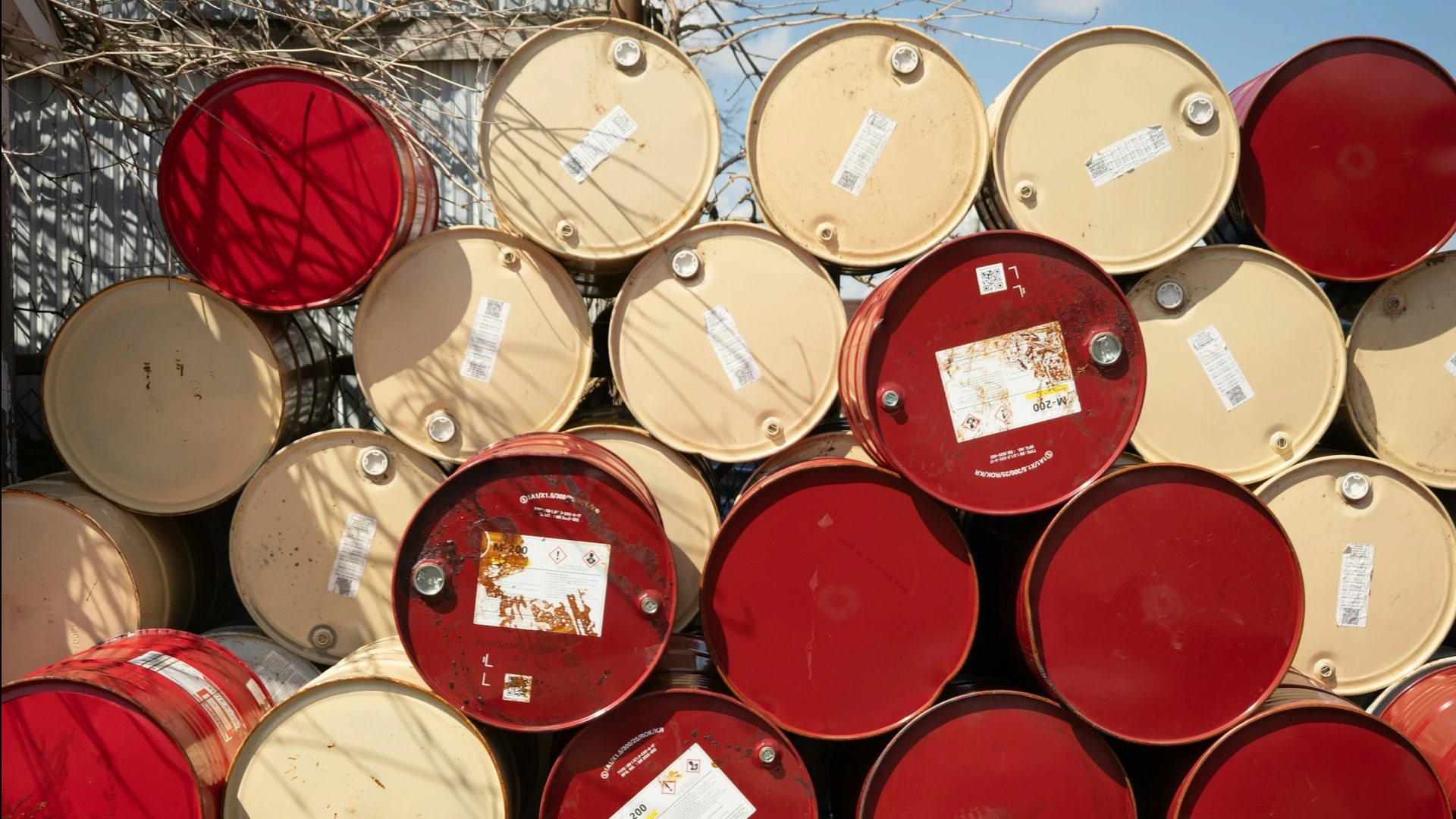
The physical market better reflects where the equilibrium price of oil "really" is / Photo: benjamin lehman / Unsplash.com
The oil market has become very unstable with the outbreak of war in the Middle East and the actual closure of the Strait of Hormuz. The human factor, among other things, leads to nervousness on it, proved Zachary Taylor, a researcher at Gulu University. Where is the fair price of oil and how much is the "psychological" premium to it?
Two markets, two levels of anxiety
Alarming warnings of dwindling oil reserves are coming with increasing frequency as the Strait of Hormuz remains effectively closed. World oil inventories are approaching a critical point, Exxon senior vice president Neil Chapman warned in late May. Chevron CEO Mike Wirth expressed essentially the same view: he expects oil prices may rise in June and July as the market is fully affected by the supply shortages of the previous months.
The market now reacts situationally, but lives by future expectations, says Sergey Suverov, investment strategist at Arikapital Management Company. He recalls that at first investors were counting on the rapid completion of the Middle East conflict - in two to three weeks, so Brent oil initially rose slightly - from some $67 per barrel in end of February to $71.23 by March 2. The expert continues: when it became clear that the conflict was dragging on, quotations went up, and their dynamics became more volatile.
Now the August futures for Brent costs $91.2, for WTI - about $88. But at the same time, physical delivery prices are closer to $115 per barrel. In reality the physical market is getting tighter every day and physical prices are a better indication of where the oil price really is, notes Kevin Morrison, an analyst for the oil and gas sector at the Institute for Energy Economics and Financial Analysis, in an exclusive commentary for Oninvest.
"This is quite a strong premium. It also disguises the premium in product prices," Morrison reasoned.
This is especially clear in the Asian oil market, where the benchmark is Singapore gasoil futures. They are trading around $155 per barrel, i.e. at a very significant premium to Brent futures.
This indicates that the tightness in oil markets is felt more at refineries, where crude oil feedstocks are harder to comeby, but turning them into product is very profitable.

Why is this happening
There is a perception distortion in the market, adds Kevin Morrison: investors don't seem to be pricing in the long-term effects of the closure of the Strait of Hormuz - at least in terms of the impact on inflation and future food supplies due to fertilizer shortages.
Besides, it is largely a matter of who trades on the "paper" markets, Morrison explains. According to him, Brent futures are a field for investment and speculative funds.
In a recent article for The Conversation, he explains that the "biggest energy crisis in history," which the IEA warned about in April, has so far been contained by four factors. Oil markets are betting on the imminent end of the war and the restoration of supply through Hormuz, other exporters have increased production (including thanks to the temporary easing of sanctions against Russia), global demand has slackened, and countries are drawing down their reserves at a record pace.
So far we have seen multiple sell offs any time President Trump says he is near a deal with Iran. Despite Tehran saying something contrary, and missiles still been fired.

Alastair Doherty, Sustainable Finance and Data Analyst at the Institute for Energy Economics and Financial Analysis, adds that while investors and authorities want to reduce dependence on commodities and their price volatility, in crises their actions often prolong dependence on the very markets that caused the shock in the first place. States start subsidizing consumers, investors move into "safer" energy assets, and energy security issues are used as an argument to maintain or even expand the use of gas and LNG.
Panic buying comes from scarcity fear. Consumers, utilities, governments and traders can't instantly substitute away from oil and gas, so they rush to secure supply or hedge exposure before prices move further. In that context, overcompensation can look rational, because the economic cost of energy rationing could be severe.

Oil "anchors"
In addition to objective factors, human psychology also affects the price of oil, says Sergey Suverov of Arikapital Management Company. Now it is difficult to mathematically assess the balance of supply and demand on the oil market: the closure of the Strait of Hormuz has deprived it of about a fifth of the world's oil supplies. At the same time, the price of oil has grown much more strongly since the beginning of the conflict - by more than a third.
There is an emotional component sitting in that difference, in addition to the risk premium and the expectation of supply shortages.
Emotions and cognitive distortions work as "amplifiers" of market fluctuations, first at the level of the individual investor, then it spreads to the entire market. This is how Zachary Taylor, a researcher from the University of Gulu (Uganda), describes the mechanism. Individual investors, due to errors in thinking and anxiety, trade more often, hold losing positions longer, overestimate recent events and ignore some of the information from the markets. This leads to systematic deviation of prices from fundamentals.
These mechanisms manifest themselves through phases of panic or irrational optimism - euphoria.
So behavioral economics is rooted in the way investment objects themselves become psychic "anchors" for people. In the study, University of Science Malaysia researchers Jasman Tuiyon and Zamri Ahmad look at market anomalies not only as expressions of cognitive distortions and anxieties, but also unconscious psychic defenses.
Oil has given investors and producing countries a sense of controlled and predictable returns. This motivates market players to hang on to oil exposure longer than cold calculation might dictate. In fact, it is almost like Stockholm syndrome in a mild version.
At the same time, the opposite urge for autonomy is growing, the desire to stop depending on what is happening in the Strait of Hormuz, on the next wave of headlines like "Oil at $150" or "Oil shortages are near".
Over the past year, investor behavior in the oil market has become more contradictory, Doherty states. All of this has led them to increasingly see renewables and electricity as safe assets, not just specialized "climate" assets.
Assets in the clean energy sector have shown good returns amid the geopolitical shock, he adds. For example, quotations of the iShares Global Clean Energy ETF index fund have grown by more than 27% since the beginning of the year. In April 2026, the fund had a record 133 million units since November 2022, and in May it had almost 145 million.
Given the gap between prices and the fundamentals of the oil market, emotions are now more important. Against this background, as the Motley Fool investment portal notes, it is reasonable to be at least partially insured. That is, not to bet only on one scenario.
Kevin Morrison, in turn, warns: it is the factors that have "saved" the market now that are setting the stage for a more painful crisis later this year, if the conflict drags on and Middle East oil does not return to the market.
This article was AI-translated and verified by a human editor