Protection against big tech defaults has become 2.5 times more expensive. Are AI-related debts no longer safe?
The market is demanding a significantly higher credit risk premium from Oracle. Photo: Tada Images / Shutterstock.com
One indicator of credit risk—credit default swap (CDS) spreads for the largest AI companies—has risen significantly over the past year. This suggests that investors and banks have begun to take a more critical view of the financial stability of hyperscalers and neo-cloud providers. CoreWeave and Oracle are causing the most concern in the market.
Debt Fears
According to estimates by the investment firm Apollo, the aggregate 5-year CDS spread for a basket of hyperscalers—Amazon, Google, Microsoft, and Oracle—reached approximately 100 basis points in September 2026, whereas a year earlier it had been below 40 basis points. In other words, the cost of protecting $10 million in debt rose from less than $40,000 to $100,000 per year.
Until the fall of 2025, CDS spreads for hyperscalers and banks were roughly at the same level and moving in the same direction. However, the gap between them began to widen when the cost of default insurance for tech giants rose sharply. Currently, this gap stands at about 60 basis points.
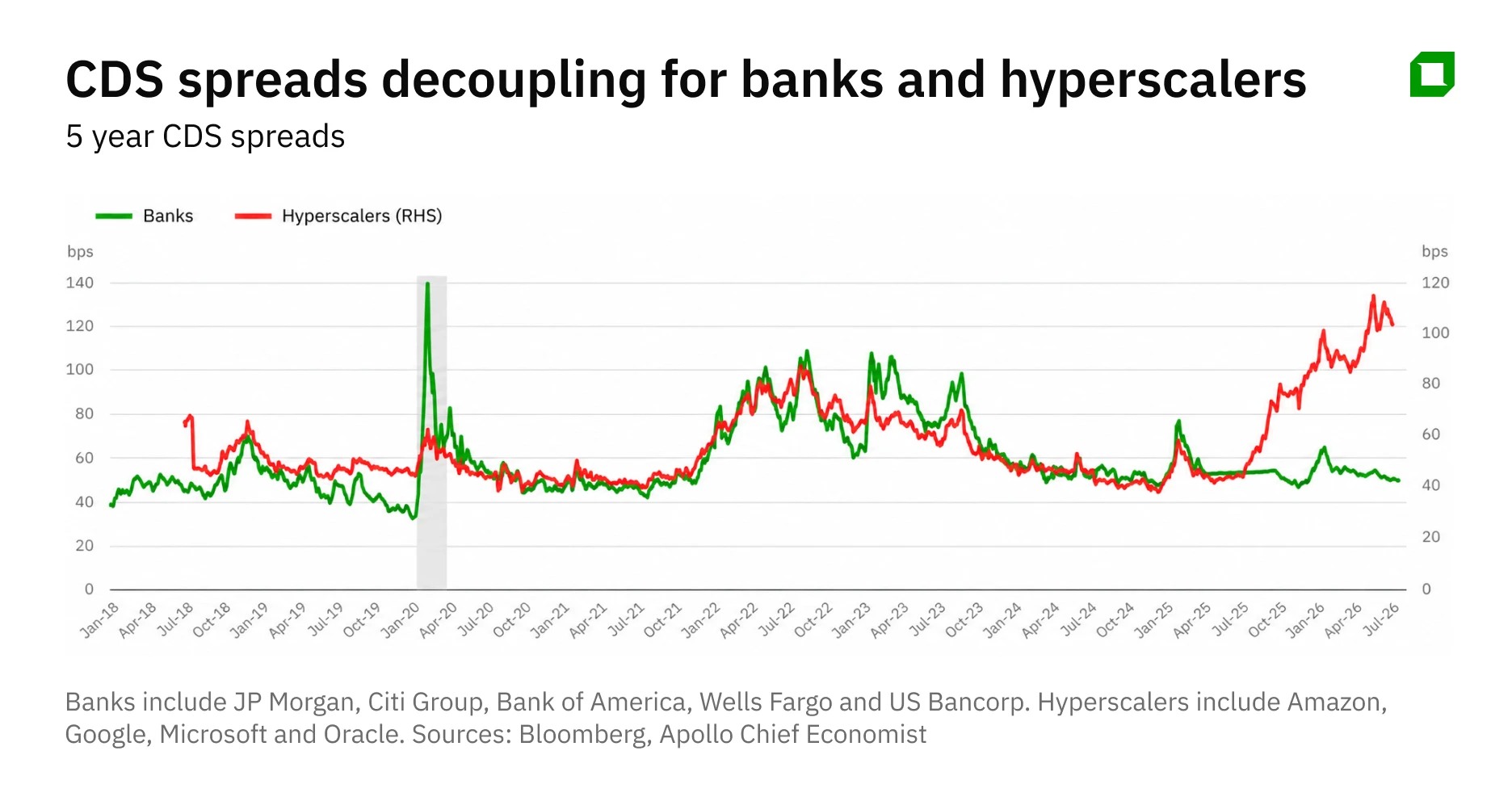
“The market is overvaluing these companies’ credit metrics—the cycle of debt-financed capital expenditures for AI development, against a backdrop of rising debt burdens, negative free cash flow, and uncertainty regarding the payback period for depreciating assets,” explains Torsten Slock, chief economist at Apollo.
According to him, this mixed trend reflects not so much the fact that banks are hedging new bond issuances by hyperscalers as a reassessment of the fundamental credit risk of these companies themselves.
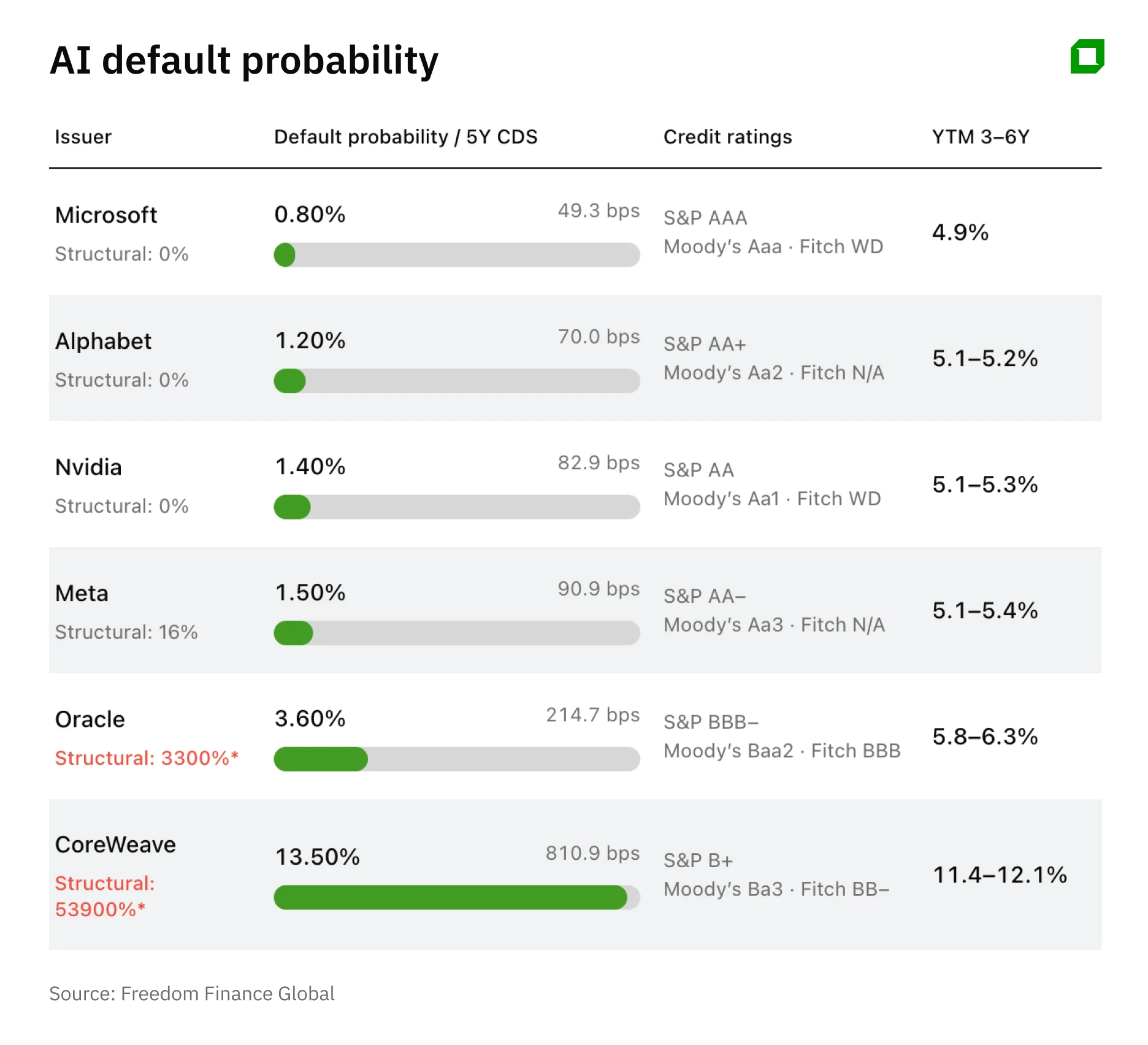
The market does not view the entire AI sector as equally risky, according to data from Freedom Finance Global reviewed by Oninvest. For example, Microsoft, Alphabet, Nvidia, and Meta all have five-year CDS spreads below 100 basis points as of September 2026, and their modeled probability of default is virtually zero.
"The difference in CDS spreads among companies is indeed significant," says Timur Lebedev, head of debt market analysis at Freedom Finance Global.
According to him, Oracle and CoreWeave are worth keeping an eye on right now.
Oracle appears weaker than its competitors: its CDS has already reached 214.7 basis points, and its bond yields range from 5.8% to 6.3%. This indicates higher financing costs for the company and reflects investors’ concerns about rising capital expenditures and debt burdens.
In the case of CoreWeave, however, the market is already demanding a significant risk premium for financing its business model: its CDS spreads currently stand at 810.9 basis points, and bond yields range from 11.4% to 12.1%.
How are banks responding?
Banks typically limit the amount of risk they can assume for a single company through loans and derivatives. But tech giants are raising more and more funds to finance AI projects and are getting involved in more complex financing structures. As a result, banks may already be approaching their established limits, according to Bloomberg.
According to Goldman Sachs, the largest hyperscalers plan to spend more than $5.3 trillion on AI and data centers between 2025 and 2030. Prior to the release of their Q1 2026 earnings reports, they had estimated their future spending at $4.5 trillion. S&P Global offers a higher estimate: over $7 trillion in spending by the six largest U.S. hyperscalers from 2025 to 2030.
As expenses rise, so does debt. According to estimates by JPMorgan Asset Management, hyperscalers will issue approximately $279 billion in bonds this year, and another $220–300 billion in 2027. By 2030, hyperscalers’ share of the U.S. investment-grade bond market could approach 10%, making them a significant part of the credit market.
But it is also important to note that official statistics underestimate the true extent of the debt burden associated with AI. Companies are increasing the share of financing under Rule 144A, which allows them to resell unregistered securities to large institutional investors without fully registering the offering with the SEC, and are increasingly turning to private placements, according to Jordan Jackson, global strategist at JPMorgan Asset Management, and Jesse Liu, a credit analyst at the bank.
The scale of these investments also calls for more innovative approaches to financing, according to analysts at S&P Global. The AI sector relies on guarantees, which companies such as Nvidia provide to their clients (CoreWeave, for example, received such guarantees). S&P Global considers such mechanisms to be akin to debt obligations, which create an additional layer of risk in the AI sector, on top of rising capital expenditures.
Given all this, banks have begun to purchase credit derivatives more actively for risk management purposes. According to DTCC data, the notional value of CDS trading linked to Microsoft, Amazon, and Oracle reached $4.6 billion in the first quarter of 2026, compared with $759 million a year earlier. The volume of CDS trades involving Meta totaled $534 million—more than double the amount from the previous quarter. Bloomberg notes that these figures may underestimate actual activity, as the DTCC limits the size of individually reported trades to $5 million.
Will there be a default?
In absolute terms, the estimated probability of default remains low for all companies except CoreWeave, says Timur Lebedev of Freedom Finance Global. But when comparing the figures side by side, the picture looks more alarming: the market is pricing in a higher probability of default in CDSs than what models and historical data indicate for companies with comparable credit ratings.
This can be attributed to several factors. First, the CDS market is less liquid, so individual trades can have a greater impact on prices. Second, investors may demand an additional premium to account for the uncertainty surrounding the AI business and its debt financing. Finally, credit ratings may react to a deteriorating situation with some delay.
“Right now, the likelihood of default has increased particularly sharply among companies with initially lower credit ratings, such as Oracle and SpaceX,” says Alexei Tretyakov, founder of the asset management firm Aricapital. Among the companies that continue to appear “fairly reliable,” he cites Alphabet and Amazon.
“Indicators that the risk has already exceeded a reasonable threshold would include the closure of the primary market for one of the major issuers (meaning they would be unable to raise new debt on acceptable terms—Ed.) or a credit rating downgrade to junk status. So far, companies have not reached that threshold, and investors are willing to buy new bond tranches, demanding an ever-higher premium each time,” adds Tretyakov.
Investors who trade CDS are among the most professional market participants, with a deep understanding of the details. And they consider the debt of the world’s most profitable companies to be riskier, according to Dean Baker, founder of the Center for Economic and Policy Research, as quoted by CNBC. In their view, there is a significant risk that AI companies will be unable to meet their financial obligations, Baker says.
The parallels between the current situation and the crisis of 2000 are clear, says Tretyakov. Moreover, in his view, the current AI boom appears to be much larger in scale than the dot-com bubble, and if it bursts, the consequences for the economy will be more severe.
This article was AI-translated and verified by a human editor