Small biotech Legend intends to compete with Big Pharma. Wall Street has faith in it.

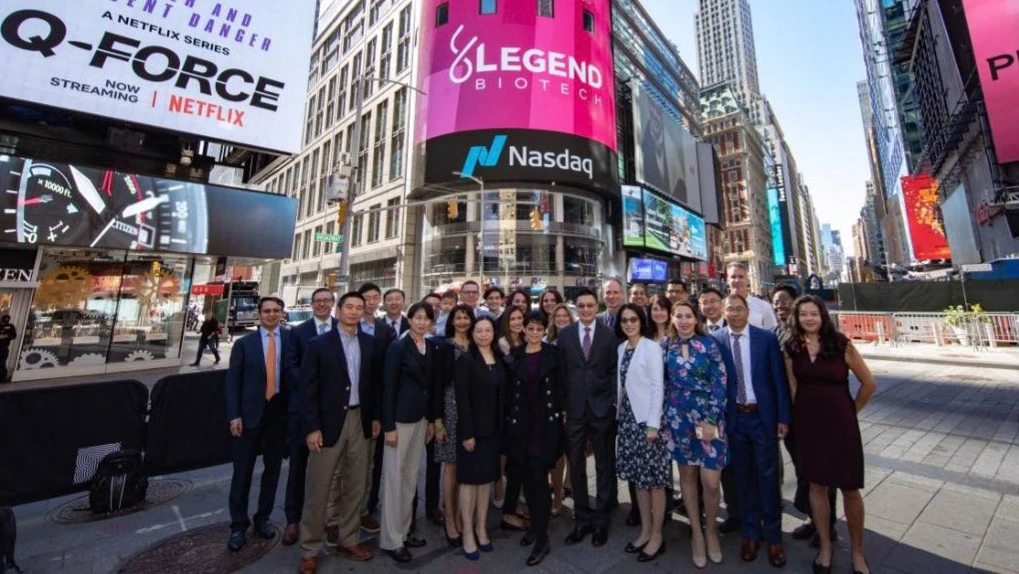
In April 2020, Legend raised $150 million from institutional investors, followed by a Nasdaq IPO in June of that year / Photo: LinkedIn / Nasdaq
Legend Biotech shares have surged more than 40% in early June after the mid-cap cancer therapy developer reported preliminary data showing that its experimental CAR-T lymphoma treatment effectively cured five of the six patients enrolled in a clinical trial.
CAR-T is a form of cellular cancer therapy that currently requires immune cells to be extracted from a patient and genetically modified in a laboratory. Legend is pursuing a fundamentally different approach: reprogramming immune cells directly inside the body.
If successful, the treatment could pose a serious challenge to existing therapies, writes BioPharma Dive, an industry news site. Wall Street is broadly upbeat on Legend as an investment, seeing potential for the stock to roughly double.
A Legend is born
Legend Biotech began as a subsidiary of another biotech company, GenScript, whose history is no less important for understanding Legend’s business and ambitions.
GenScript was founded in the U.S. in 2002 by Dr. Frank Zhang and partners Eric Wang and Luci Wang with just $5,000 in startup capital. Zhang set out to solve a problem faced by many researchers and pharmaceutical companies: the labor-intensive and time-consuming process of gene synthesis.
Initially, GenScript synthesized DNA on behalf of other companies. In 2004, it opened a manufacturing center in China and expanded into protein and antibody production. The business later diversified further, leading to the creation of two subsidiaries: enzyme producer Bestzyme in 2013 and cancer cell therapy developer Legend in 2014.
GenScript shares began trading in Hong Kong in 2015 and have gained around 750% since then. In recognition of his role in accelerating innovation, Frank Zhang was named a finalist for EY’s regional Entrepreneur Of The Year award in 2026. Past winners of the award have included Google cofounders Sergey Brin and Larry Page, as well as Amazon founder Jeff Bezos.
Cancer cells in the crosshairs
For its first two years, Legend, then known as the Legend Project, operated out of a space no larger than a freight elevator. Its first program was a conventional CAR-T therapy for multiple myeloma, an aggressive blood cancer.
Most approved myeloma treatments at the time were not particularly effective. Because there are no solid tumors or masses that can be surgically removed or precisely targeted, cancer cells often remain in the body even after treatment, according to the charity Myeloma UK. Over time, those cells begin multiplying again, causing relapse and making multiple myeloma effectively incurable. CAR-T therapy genetically modifies a patient’s immune cells, teaching them to recognize and destroy cancer cells.
In 2017, Legend secured the backing of a major partner – Janssen, the pharmaceutical subsidiary of Johnson & Johnson. The companies agreed to jointly develop and commercialize a CAR-T treatment for multiple myeloma. Under the agreement, Legend received a $350 million upfront payment, became eligible for milestone payments as development progressed, and secured rights to 50% of future global profits from the therapy and 70% of profits generated in China.
In April 2020, the company raised $150 million from institutional investors and, two months later, completed an IPO on the Nasdaq alongside its separation from GenScript. In the offering, Legend sold around 21.2 million American depositary shares (ADSs), each representing two ordinary shares, at $23 per ADS. On the first day of trading, the stock surged 85% to $42.56 per ADS.
The proceeds were needed in part to complete clinical trials of its CAR-T therapy and fund regulatory approval efforts. In 2022, the treatment, branded Carvykti, won approval from the U.S. Food and Drug Administration and the European Commission. In its first year on the market, Carvykti helped boost Legend’s revenue by 71% to $117 million. For 2025, the company reported revenue growth of 64% year over year to $1 billion. In the first quarter of 2026 alone, Carvykti generated around $597 million in revenue, up 62% year over year.
Now an established player in cell therapy, Legend has turned its attention to in vivo approaches, in which immune cells are modified directly inside the patient’s body, Biopharma Dive wrote. Preliminary clinical data released in June showed that tumors shrank or disappeared in all six lymphoma patients treated with its experimental therapy.
Outlook
The study results raise hopes that Legend’s therapy could become a serious competitor to ex vivo treatments, which rely on laboratory-based cell modification, writes BioPharma Dive.
The CAR-T market is currently worth around $3 billion, yet only about 20% of eligible patients receive treatment, Barclays said in a research note seen by Oninvest, citing the management. Ex vivo therapies are difficult to manufacture, expensive, and face logistical challenges, according to data from the College of American Pathologists, limiting their commercial potential. Legend believes in vivo CAR-T therapy could significantly expand access to cell therapy and grow the market to approximately $15 billion, Barclays said.
While the data released by Legend are encouraging, it is still too early to draw firm conclusions, analysts at RBC Capital Markets said. Competitors have set a high bar, and meaningful comparisons will require longer patient follow-up, they wrote in a note (seen by Oninvest).
One such competitor is Kelonia Therapeutics, whose own therapy is also in the early stages of development. In April, pharmaceutical giant Lilly reached an agreement to acquire Kelonia in a deal worth up to $7 billion, including a $3.25 billion upfront payment. The acquisition highlights growing interest from big pharma in in vivo CAR-T therapies, H.C. Wainwright wrote in a note released after Legend published its data (seen by Oninvest).
RBC also believes the results are strategically important because they provide a potential growth avenue for Legend beyond Carvykti. The analysts estimate Carvykti’s sales potential at $8 billion.
According to its website, Legend currently has 11 ex vivo CAR-T therapies and three in vivo CAR-T therapies in early-stage development.
Wall Street is upbeat on the stock. It has 13 "buy" calls from analysts versus two "hold" ratings. The average target price is $57.50 per share, implying upside of almost 100% versus the stock’s closing price on Wednesday.