Where to find outstripping returns in EM small caps in 2026


The dynamics of small caps in emerging markets reflect domestic economic processes to a greater extent, while global trends tend to drive the performance of large companies / Photo: Shutterstock.com
Last year showed that small caps in emerging markets can compete with large issuers, despite a lag that persisted through the third quarter. For 2025, the return of the Equal Weight EM Small Cap Index, put together by analyst Aldiyar Anuarbekov for Oninvest, amounted to 18.25% in dollar terms*. For comparison: the broad-market S&P 500 index grew 16.65%, while the smid-cap Russell 2000 rose 11.21% last year. The 8.06% increase in the Cap Weight EM Small Cap Index, meanwhile, indicates that the gains were more evenly distributed rather than concentrated in a small number of large stocks.
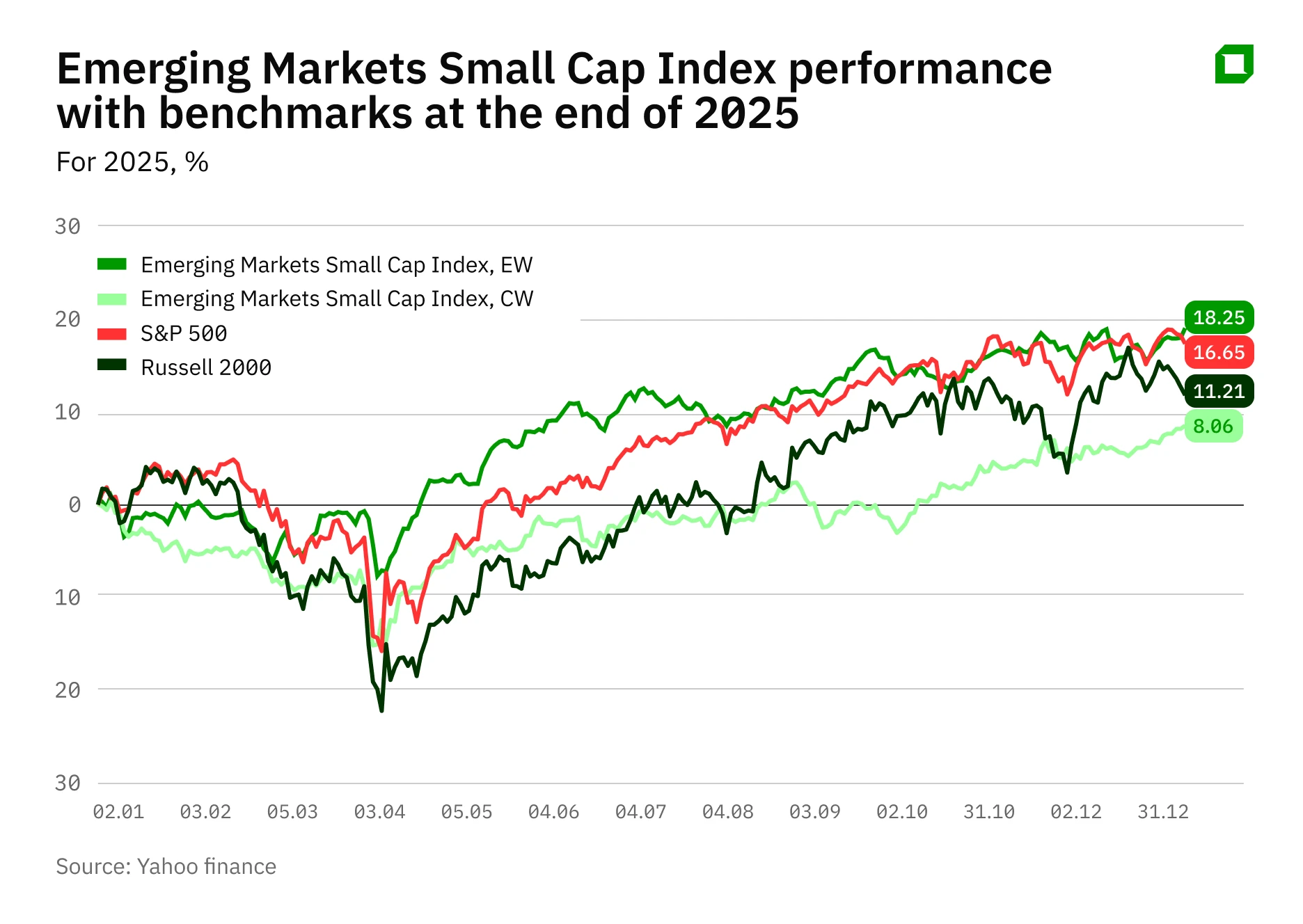
This result is typical for the segment: small-cap indexes in emerging markets tend to react more strongly to local economic and sector developments than large issuers. This is highlighted by MSCI in its description of its EM Small Cap Index: "the small-cap segment tends to capture more local economic and sector characteristics relative to larger Emerging Markets capitalization segments."
Year-to-date leaders
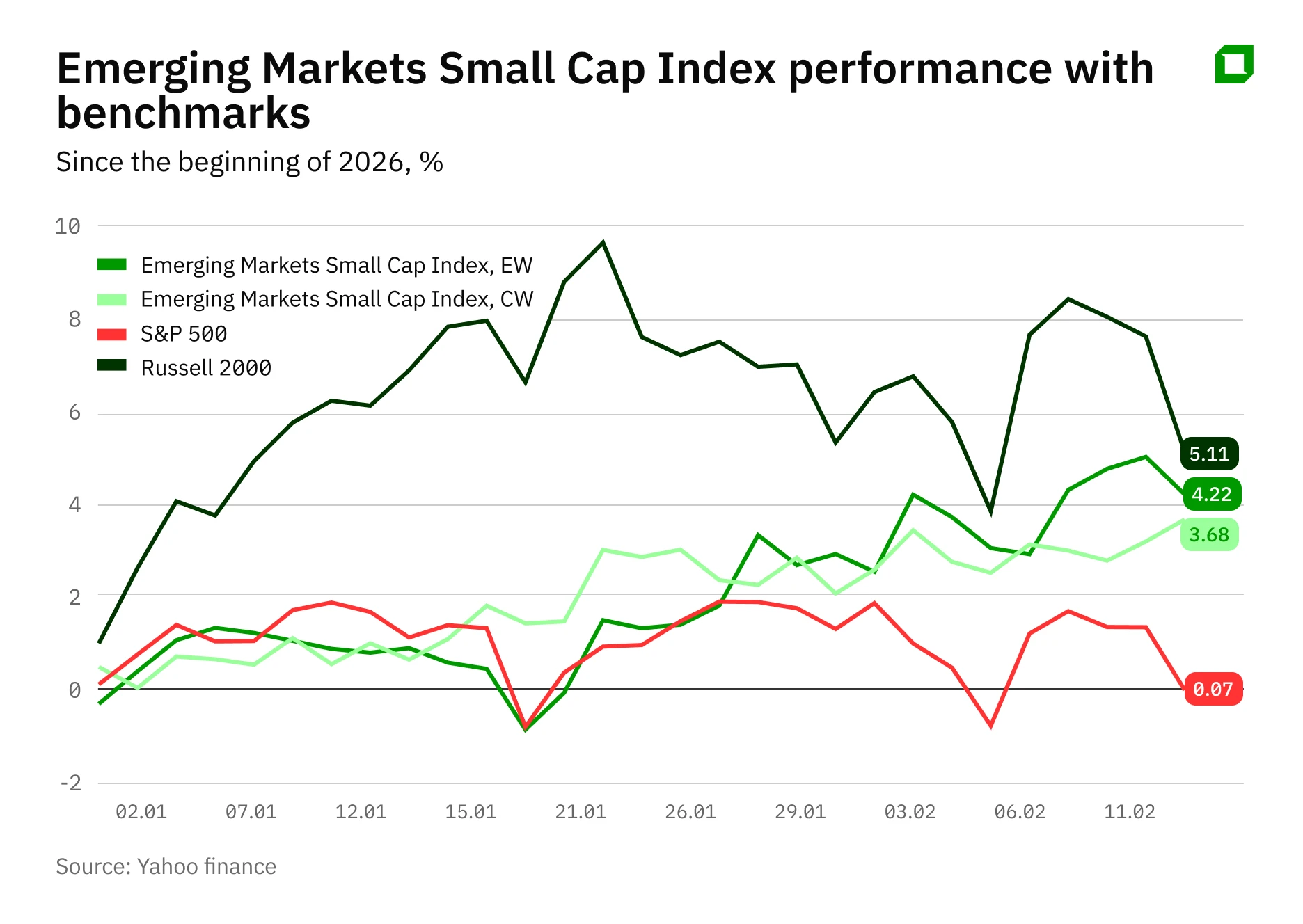
Since the beginning of 2026, the EW index has gained 4.2% in dollar terms (here and below the data is as of February 12), while the Russell 2000 has advanced 5.11% and the S&P 500 only 0.07%.
A total of 154 out of 239 companies in Anuarbekov's index are trading higher. At the same time, performance differs markedly by country: in Brazil 49 out of 57 companies have gained year to date, while in India only 22 out of 61 are up. This is an important signal – the small-cap segment in emerging markets is currently driven primarily by local stories rather than by a single global trend.
Below Anuarbekov discusses three stocks from his index that offer upside in 2026.
Bajaj Consumer Care: Indian FMCG
Bajaj Consumer Care is one of the prominent players in the personal-care market. The company has historically been associated primarily with its flagship product, Bajaj Almond Drops hair oil. Since the beginning of 2026, Bajaj Consumer Care shares have gained 46.32% in dollar terms (here and below the author's calculations are presented) – a notable performance for a defensive sector.
In the company's third quarter ended December 31, revenue rose 25% year over year to INR2.9 billion (about $31.9 million), while net income increased 72.9% to INR476 million ($5.3 million).
In May 2025, the company completed the buyout of the remaining 51% stake in Vishal Personal Care (which owns the brand Banjara's), fully consolidating the asset and expanding the product lineup in the hair and skin-care segment. For a business historically dependent on a single core product, broadening the product portfolio increases revenue resilience to changes in demand and fluctuations in raw-material prices.
Analysts at ICICI Securities reiterated their “buy” recommendation with a target price of INR450 per share, implying about 19% upside from current prices. At the same time, ICICI Securities noted risks tied to the company’s dependence on Almond Drops hair oil and its sensitivity to commodity prices.
MTAR Technologies: Indian infrastructure and defense
MTAR Technologies is one of the few Indian suppliers of high-precision components for nuclear power and defense and aerospace programs, areas where clients prioritize proven quality and long-term contracts that provide multiyear order-book visibility. In the third quarter ended December 31, operating revenue rose 59.3% year over year to about INR2.8 billion ($30.9 million), while net income jumped 117.3% to INR346.9 million ($3.9 million).
Since the beginning of 2026, MTAR Technologies shares have risen about 46% in dollar terms. For investors, the key factor is not consumer demand but contract execution, transparency of revenue forecasts, and the size of the order book. For example, in December the company announced contracts related to units 5 and 6 of the Kaiga nuclear power plant under construction in India with deliveries scheduled in stages through February 2030.
Motilal Oswal, in a January 30 report seen by Oninvest, maintained its “buy” recommendation with a target price of INR3,900 per share. Analysts at Phillip Securities also assign a “buy” rating with a target price of INR4,441 per share, implying about 25% upside from the current level.
MRV: Housing in Brazil
MRV Engenharia e Participações is a Brazilian residential real estate developer and one of the largest players in the affordable housing segment with mass-market projects across the country.
In its report for the third quarter of 2025, the management highlighted improving profitability and a reduction in leverage. Net debt to EBITDA for the first nine months of 2025 declined to 1.1 versus 1.9 a year earlier and 6.6 in 2022. In the third quarter, net revenue rose 14.7% year over year to BRL2.6 billion ($498 million), while net income increased 32.4% to BRL813 million ($152 million).
In the quarterly report, the company also pointed to an increase in the price cap under the federal Minha Casa Minha Vida home purchase assistance program, which could support demand in segments where MRV operates. For developers such as MRV, the program remains one of the key sources of structural demand in the affordable housing market.
MRV also has an additional intangible element in its investment story: it ranked in the top 10 out of 250 participants in the AI Lighthouse Awards and was named the most valuable brand in the construction sector by TM20 Branding and InfoMoney.
MRV shares are up about 34% year to date. BTG Pactual, in a January 22 report, maintained its “buy” recommendation with a target price of BRL12 per share, implying about 22% upside. UBS, in a January 13 report, also maintained its “buy” recommendation with a target price of BRL12 per share.
Outlook for rest of 2026
Emerging markets enter 2026 with clear structural support. According to Bloomberg Intelligence, strategies based on selecting companies using specific factors in emerging markets have historically commanded a higher premium – particularly those using value and momentum factors. In practice, two simple approaches have tended to perform best over the long run: buying companies that appear cheap relative to their fundamentals and buying companies that are already demonstrating strong share price growth.
The key question for 2026 is whether the expected improvement in corporate earnings will materialize. Markets may assign higher valuations to emerging-market equities this year either because investors become willing to accept higher multiples or as earnings forecasts are revised upward. According to Bloomberg Intelligence, earnings estimates for emerging markets were unusually accurate in 2025, and the MSCI EM index consensus points to earnings growth of about 23% in 2026 after roughly 16% in 2025. This is a relatively rare situation in which forecasts appear not only optimistic but also comparatively credible.
At the same time, the regional breakdown remains mixed. In Latin America, 2026 has started strongly after a record 2025. Bloomberg Intelligence attributes this to expanding multiples and upward revisions to earnings forecasts, in part on the back of higher metal prices that have supported commodity producers. In Brazil, easing financial conditions and recovering domestic demand are creating a more favorable environment for non-resource sectors, including mass-market housing developers. The coming reporting season will test whether this combination of export support and domestic demand proves sustainable.
This material does not constitute individualized investment advice.
* The Oninvest Emerging Markets Small Cap Index includes 239 companies from emerging markets and is calculated on an equal-weight basis. Returns are recalculated in dollars to reflect currency dynamics.