Trump hasn't said when the Iran war will end. The economy has already set itself up for a crisis
Neither governments nor businesses are yet implementing long-term solutions to adapt to a potential crisis

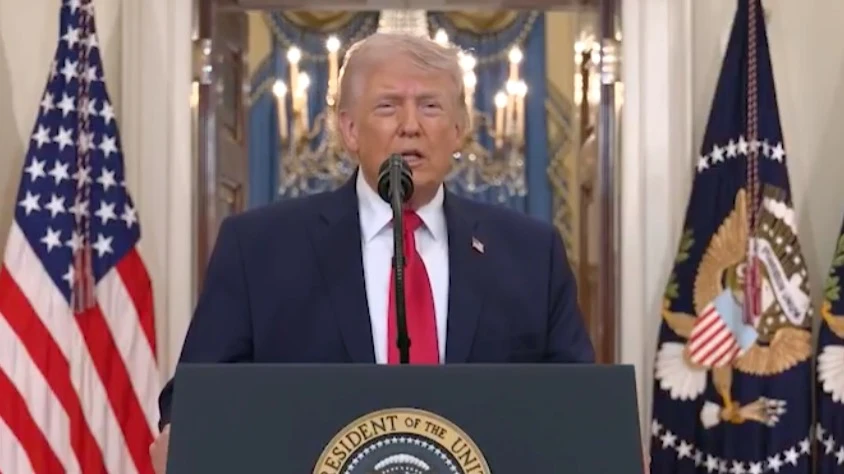
US President Donald Trump said on April 1 that the military operation in Iran is "very close" to completion, but shifted responsibility for unblocking the Strait of Hormuz to other countries. Photo: The White House / X
US President Donald Trump said in a speech on April 1 that the military operation in Iran is "very close" to completion, but also promised more strikes on Iran in the next 2-3 weeks and shifted responsibility for unblocking the Strait of Hormuz to other countries. The blockade of the strait has already forced governments in different parts of the world to take urgent action in response to the commodity shock. The solutions are many and all different except for one detail - they operate on a horizon of a few quarters. Economists believe that the war in Iran has already had serious consequences for economies around the world.
Not just an oil story
Over the past 10 days, predictions about the impact of Iran's blockade of the Strait of Hormuz on the global economy have gotten noticeably bleaker: it's no longer just about expensive oil, but also about the risks of stagflation and recession - a classic blow to economic growth, stoking inflation and damaging global trade.
The OECD wrote in its March report that the conflict in the Middle East is "testing the resilience of the global economy." And the organization's economists, though they left the global growth forecast for this year unchanged at 2.9%, lowered it for 2027 from 3.1% to 3%. They also warned that the new energy shock is driving up inflation and that economic growth itself is becoming "more fragile".
On March 30, the IMF described the same mechanism: energy, trade and financial transaction costs become the three channels through which the crisis is transmitted around the world.
While war could affect the global economy in different ways, all scenarios boil down to higher inflation and slower growth. In Asia and parts of Latin America, where inflation has previously remained relatively low, rising energy and food prices will test the sustainability of inflation expectations, especially in countries with weaker currencies and high dependence on energy imports.
In poor countries in Africa, parts of the Middle East and Central America, rising food prices have serious social and economic costs.
In Europe, the new price hike will be superimposed on an already existing rise in the cost of living, the IMF writes.
German economic research institute Ifo has already estimated that due to the war in the Middle East, Germany's economy - Europe's largest - will grow almost twice as slow this year as it was expected a few months ago - GDP will grow by 0.6%, although back in September the forecast was 1.3%, Bloomberg quoted the study as saying.
Oxford Economics experts wondered what would happen if the Strait of Hormuz were closed for six months, all compounded by Iranian strikes on alternative pipeline routes through Saudi Arabia and the UAE and renewed Houthi attacks in the Red Sea. They called it a scenario of a "protracted war with Iran."
According to their calculations, global inflation will reach 7.7% this year, close to its peak in 2022, and the world economy will face a full-scale recession. Global GDP growth slows to 1.4% this year, 1.2 percentage points below Oxford Economics' baseline scenario, followed by a modest recovery to 2.1% in 2027. The US and most major advanced economies will fall into recession, with Chinese growth slowing to 3.4% (vs. 5% in 2025). The Gulf countries will be hardest hit - their GDP will fall by more than 8% in 2026 - followed by a sharp rebound as production recovers.
Why do economists have negative forecasts? The explanation should be sought in the oil market. According to Reuters, analysts' new consensus forecast for Brent for 2026 rose to $82.85 a barrel, up from $63.85 a month earlier. This is the largest monthly revision in the survey's history.
In a more severe scenario, if the blockade of the Strait of Hormuz drags on, some estimates allow prices to rise to the $190 a barrel level.
The World Bank wrote on March 26 that since the end of February, oil prices have risen by nearly 40%, liquefied natural gas prices in Asia by nearly two-thirds, and nitrogen fertilizer prices by about 50%. Thus Hormuz is fast becoming a tax on everything: transportation, agriculture, chemicals, import-dependent manufacturing and, ultimately, the consumer.
This is the unpleasant feature of a potential crisis: it starts out as an energy crisis, but ends up working as an overall cost spike for the global economy.
Short adaptation
The first reaction of the states was predictable: to release reserves to the market and buy time. On March 11, the International Energy Agency announced the largest collective intervention in its history: 400 million barrels from the strategic reserves of the 32 member countries of the organization were offered to the market. This step is important not only for its scale. It shows that governments see the crisis not as a market fluctuation, but as a full-fledged supply disruption that requires an emergency response.
The second line of adaptation is the search for workarounds. Saudi Arabia has increased exports through the port of Yanbu al-Bahr on the Red Sea. According to Reuters, by the end of March, shipments through Yanbu came to 4.6 million bpd, which is almost close to the level of the technical limit of the port (5 million bpd). Reuters notes that Yanbu has effectively become the main emergency window for Saudi oil.
But this route cannot fully replace transit through Hormuz, and it did not save Saudi Arabia's oil exports either - in March, according to Bloomberg calculations based on tanker tracking data, they fell by half.
Barclays estimates that with a prolonged transit disruption, the loss of global oil supply could amount to 13-14 million barrels per day. This is a level that cannot be compensated for by logistics operations "bypassing Iran.
The third line is to support private consumers and work with demand. Thus, according to Reuters, Australia is ready to reduce fuel taxes, India - excise taxes on gasoline and diesel, South Korea is discussing restrictions on driving in case of further price increases.
This is a familiar crisis set: when the market cannot quickly reduce the price, the state tries to at least mitigate the political effect. But this adaptation has a short horizon of action. All the current measures look workable for weeks and perhaps a couple of months. For quarters ahead, they no longer solve the problem, but only distribute its cost differently between the state budget, businesses, and households.
Ending the war will not mean solving the problems
Perhaps given the long-term risks, the White House wants this war to be shorter than it seemed to everyone even a week ago.
In his April 1 address to the nation, U.S. President Donald Trump said the military objectives of the campaign were almost achieved and its end was "very near," but warned that the U.S. would launch new strikes against Iran in the next two to three weeks that would push the country "back to the stone age."
A separate block of his speech was devoted to oil and prices. Trump linked the jump in oil and gasoline prices to the war and the situation around the Strait of Hormuz, emphasizing that the U.S., according to him, is less dependent on this route due to its own production. In doing so, he effectively shifted responsibility for security of supply to allies, urging countries that need oil from the region to push for the opening of the strait themselves. Markets took this as a signal that there would be no quick fix: oil futures rose significantly after the speech.
On March 31, Trump already said that the U.S. could end the campaign against Iran within two to three weeks. After that, Brent futures fell below $100 per barrel on expectations of a sooner Washington's exit from the conflict. The stock market went up. But, writes Bloomberg, Wall Street attributes this to the winding down of short positions, rather than a change in investor sentiment in connection with the war.
Even earlier, on March 26, Trump announced a 10-day pause in strikes on Iran's energy infrastructure, explaining that negotiations with Iran were "going very well." But these Trump's intentions were primarily about the pace of the fighting, not the pace of energy restoration.
And this is where the unpleasant line between politics and economics comes into play. War can be stopped quickly. But it can take months to restore the energy infrastructure and bring it back to normal. The most obvious example is Qatar. Iranian strikes knocked out 17% of Qatar's LNG export capacity, which will take three to five years to repair.
Plus we need to consider other elements of energy infrastructure: restoring shipping, lower insurance premiums, etc.
The operation against Iran may end politically before it ends economically. Damage to Qatari facilities has already supported quotations of U.S. LNG companies, because the market realizes: the fallout of Qatari LNG supplies is not a story for days, but for a long period.
The Gulf states have already made it clear to Washington that a ceasefire itself is not enough: they need guarantees that Iran will not be able to use Hormuz and strikes on energy facilities as a tool to pressure its neighbors again.
This article was AI-translated and verified by a human editor