Where to Invest $10,000 to Gain Protection and Income in a Bear Market for Bonds


Rising public debt in the world's largest economies and increased borrowing by hyperscalers are fueling investor concerns. Photo: Chenyu Guan / Unsplash.com
The debt market crisis is becoming one of the main market topics. The International Monetary Fund has called on countries to reduce their public debt—the average level is approaching 100% of GDP, the highest since World War II. The fund’s economists believe that government bond yields could rise sharply and erratically due to accelerating inflation, rising government debt, and increased borrowing related to the development of AI. Rising government bond yields are being observed in both Europe and the United States. And Ray Dalio, founder of the hedge fund Bridgewater Associates, believes that the bond market bear market could prove to be protracted.
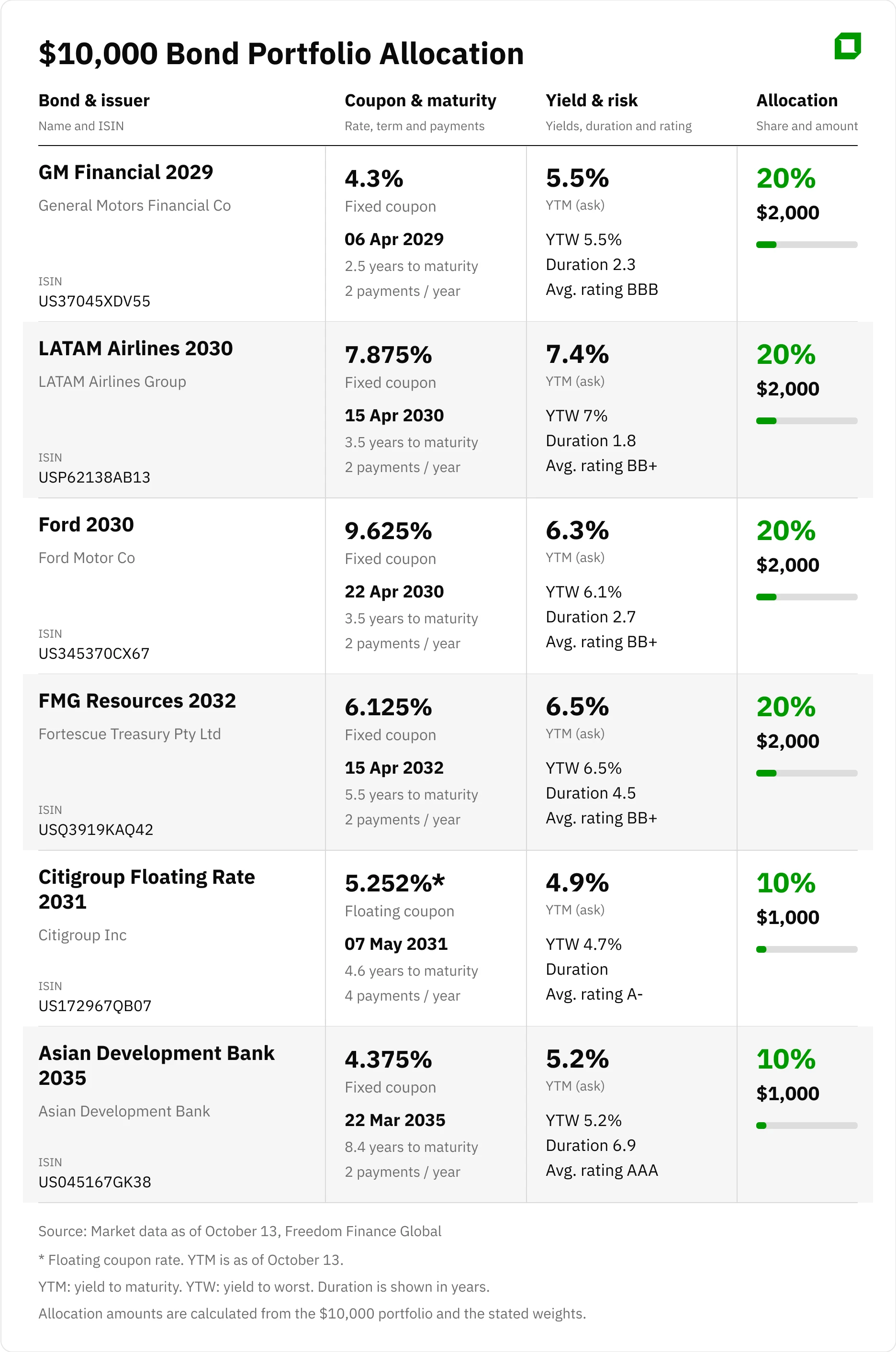
How can an investor protect their capital and generate a steady income without betting on a specific market scenario or central bank actions? Vadim Merkulov, Director of the Analytics Department at Freedom Finance Global, recommends a portfolio consisting of six corporate bond issues.
All-Weather Briefcase
In the fixed-income market, we focus on the average duration of the portfolio and give preference to investment-grade bonds, with the exception of certain issuances by hyperscalers. The concerns here are clear: the rise in AI spending by the largest companies and the volume of debt issued to finance it not only raises more and more questions among investors but also, in and of itself, constitutes a source of inflationary pressure and a risk to the debt market.

The selection for the $10,000 portfolio includes both fixed-rate and floating-rate securities. The latter are once again gaining relevance. Investors expect monetary policy to tighten further, and such securities help mitigate interest rate risk and even increase coupon payments as rates rise.
The primary objective of this portfolio is to preserve capital and generate stable income, rather than to maximize returns by taking on increased risk. In a sense, it can be called an “all-weather” portfolio—it allows for the possibility of further rate hikes, including sharp ones, while also providing protection in the event that regulators do not significantly tighten policy or choose not to raise rates at all. An additional advantage is the distribution of coupon payments over time, which provides the investor with a more consistent cash flow.
— General Motors Financial Bonds
This BBB-rated issue, maturing in 2029, combines acceptable credit quality with moderate duration.
GM Financial is the financial division of General Motors that provides auto loans and financing for dealerships, as well as auto leases. The automotive giant’s subsidiary continues to post solid results: its adjusted earnings before interest and taxes (EBIT) for the first half of 2026 totaled approximately $1.3 billion. The quality of the loan portfolio also remains high: delinquency rates and write-offs do not raise significant concerns.
Taking these factors into account, this issue appears to be a good fit for the current portfolio structure, which is focused on capital preservation and stable income.
— LATAM Airlines Group Bonds
The South American company’s net income in the second quarter of this year was $125 million, down 48% year-over-year. Revenue rose by nearly 28% compared to the same period last year, reaching $4.2 billion. The company itself described the second quarter as “particularly challenging” in terms of jet fuel prices. Related expenses rose by more than 90% year-over-year, while the actual fuel price, after accounting for hedging, increased by 81.3%.
At the same time, the company raised its EBITDA forecast for 2026 to $4.1–4.4 billion (from $3.8–4.2 billion), and the debt-to-EBITDA ratio will be 1.6 (compared with 1.8 in the May forecast).
The main risks for the company are related to a possible further increase in fuel costs due to continued escalation in the oil market. Our 12-month base-case scenario assumes that the average oil price will be $70, so these risks do not yet appear to be critical, although further price increases could put pressure on financial results. There is also a risk of potential tariff restrictions, but in my view, this risk is minimal.
On September 21, S&P raised the company's credit rating from BB to BB+.
— Ford Motor Company Bonds
This corporate bond issue has a BB+ rating. This is the highest rating in the speculative-grade category.
Why did we choose this issue? Ford’s second-quarter operating results point to an improving situation: Ford Blue sales are growing, and losses in the electric vehicle division are shrinking. In July, the company raised its full-year forecast for earnings before interest and taxes (EBIT) to $10–11 billion (from $8.5–10.5 billion) and its adjusted free cash flow forecast to $6–7 billion (from $5–6 billion). Ford has sufficient liquidity and financial strength.
Yes, it still faces risks related to consumers switching to electric vehicles due to the fuel crisis. From 2023 to 2025, Ford’s losses from its electric vehicle business reached $13 billion, prompting the company to rethink its strategy and scale back its ambitions in this segment. In 2026, Ford expects a $4 billion loss in this sector.
If the negative scenario plays out, Ford’s credit rating could fall below investment grade, resulting in a downgrade to “fallen angel” status (in 2025, for example, S&P changed its outlook on the company’s rating and that of its subsidiary, Ford Motor Credit, from stable to negative). For now, however, these risks can be considered manageable. Nevertheless, the issue requires closer monitoring.
— Fortescue Treasury Pty Bonds
This is an issue by a subsidiary of the Australian mining giant Fortescue. It has one of the longest durations in the portfolio. This means that the securities are sensitive to changes in their own market yield. However, the issue may offer additional upside potential, particularly in the event of monetary policy easing. The company’s main fundamental risks are related to iron ore prices and demand trends in China. However, its current metrics do not yet indicate a significant deterioration in credit quality.
— Citigroup Bonds
These securities primarily serve as a hedge against rising market interest rates in the portfolio, including in the event of a tightening of monetary policy.
A floating-rate coupon allows investors to expect interest payments to rise as the base rate increases, while the bond’s price is typically less sensitive to rate changes than that of comparable fixed-rate bonds.
We do not view further aggressive tightening of the Fed’s policy as the base case scenario. According to our forecast, there will be one more rate hike by the end of the year and another one next year, for a total of approximately 0.5 percentage points. This should not significantly affect the investment appeal of the issue.
— Asian Development Bank bonds
This security in the portfolio—which, by the way, has the highest credit rating of AAA—can also be considered a defensive asset. The issue is most sensitive to changes in interest rates due to its high duration. In the event of an economic slowdown and subsequent monetary policy easing, it could benefit from a decline in market yields. In the opposite scenario—if rates continue to rise—price performance could be negative.
Thus, this bond complements Citigroup’s floating-rate bonds: while the floating-rate bond protects the portfolio against rising interest rates, the long-term issue from the Asian Development Bank offers the potential for capital appreciation when rates fall.
This is not an investment recommendation.
This article was AI-translated and verified by a human editor