STOXX Europe 600 index down 1.9%: why our brains expect war to collapse


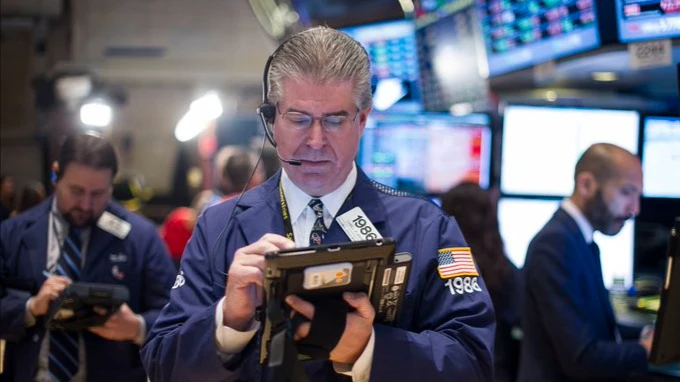
Morgan Stanley believes that war in the Middle East is no reason to change the optimistic outlook for U.S. stocks - unless there is a sharp and sustained rise in oil prices. Photo: Pete Marovich/Getty Images
The main European indices collapsed following the Asian indices as investors react to the US and Israel's operation against Iran. Last weekend was a test for millions of people around the world: the images of Iranian bombing, US fighter jets shot down by "friendly fire" and a deserted mall in Dubai are shocking: one of the first reactions is not a calculation of asset returns, but pure, evolutionary fear or at least anxiety. Psychologist Michael Tegin urges us not to fuss and to look at the facts: the market almost always recovers faster than we can imagine.
From Pearl Harbor to Tehran: analyzing fear
Almost 85 years ago in 1941, one of the biggest shocks to the world economy and the entire world order occurred - the attack on Pearl Harbor, the entry of the United States into the world war. The indices collapsed and it seemed that the world economy was over. In fact, it took 307 days for the market to not just recover, but even go up. If it is not a global war, markets recover from shock much faster: researchers from CFRA Research in 2023 analyzed more than two dozen major geopolitical crises since World War II - the average drop in the S&P 500 index in response to a war shock is 1.2%, and full recovery takes an average of 47 days.
The conclusion is self-evident: the market first catastrophically overestimates the scale of the disaster, and then just as willingly optimistically believes in the high speed of recovery.
Why does our brain overestimate everything?
Humans need to survive, and Homo Sapiens has been doing a pretty good job of it for about 300,000 years. The secret of success is that evolution has taught us to avoid various unpleasant or dangerous situations rather than to take risks and see what happens. As a result, we have developed a dual system of information processing: automatic - on a semi-conscious level and conscious - controlled.
Each of these has "bugs": cognitive distortions and logical fallacies. Cognitive Behavioral Psychology and Therapy (CBT) identifies several of the most powerful and active distortions that are activated by seeing headlines about bombings:
Catastrophizing: the brain's tendency to build up a chain of events to the worst possible ending. "Strikes on Iran -> Closure of the Strait of Hormuz -> Oil at $200 -> Collapse of the world economy". The brain perceives this scenario not as a mere possibility, which is realizable with a 1% probability, but as an accomplished or really coming fact.
Selective abstraction. Paying attention only to negative details, ignoring the big picture, i.e. it is as if we do not see the positive and neutral factors.
Accessibility heuristic. It is easier for Ma to believe what we see with our own eyes, because it is more convincing. The same applies to news with vivid pictures: videos of explosions on social networks leave a stronger impression than a dry analytical report from even the most respected company. We overestimate the significance of high-profile events and underestimate the inertia of the global economy and even our own behavior, because many people are probably just taking a wait-and-see attitude and watching what happens next.
Emotional justification. This distortion works on a principle similar to the availability heuristic: "If I am scared, then the situation is really terrible". That is, we take our feelings as fact, which is true in itself, but we also assign it the role of a real factor that acts as an objective market indicator.
Reassessing recovery: when fear is forgotten
When the passage of time reveals that the worst of the catastrophe never happened, the reverse mechanism kicks in. Investors who have just sold out in a panic experience fear of lost profits and often guilt for their previous irrational behavior. Both of these feelings can prompt what psychoanalysis calls "reparation." This is not about paying the aggressor to the victimized state, but about the unconscious need to "repair" the self-inflicted damage and restore the former sense of calm.
In psychoanalysis, for example, in the works of British analyst Melanie Klein, reparation is seen as a defense mechanism that is triggered when an investor realizes that in a fit of panic he or she has "destroyed" his or her portfolio. Therefore, a person begins to feverishly "fix" reality and may, for example, "vacuum" the market, driving prices above reasonable limits. This is the very same "recovery reassessment" that studies talk about: the emotional pendulum just swung sharply in the other direction.
Three techniques to keep your peace of mind and your money
To avoid making purchases or sales that you may regret under the influence of emotions and cognitive distortions, you can use techniques to "balance" your thoughts and feelings with reality.
Decentering" technique: helps you stop taking your thoughts and ideas as axioms. Imagine you are looking at a chart of the S&P 500 not for today, but for 10 years. There you can see little nicks in 2022, 2023, and April 2024, because the same "fateful" conflicts happened then too. From the height of the decade and the market's lack of emotion, however, they are barely noticeable.
4-Hour Rule: Let the market react as if it were a teenager. Don't make trades in the first hours of trading after a weekend of bad news. Not only is the explosion in Tehran ruling the market at this time, but margin calls explode on fear of loss and global change. Wait for algorithms and institutional investors to come into play, the latter have slightly more complex and longer decision-making procedures, but potentially more balanced.
Exposition to facts: when you read the news, try to pay attention first of all to dry summaries: what objects are affected, who exactly suffered, and not to materials with headlines "The world is on the verge of another apocalypse". The latter is not about facts, but about opinions, and opinions can be of any kind, but we do not have to agree with all of them. Facts are grounding, opinions are stirring up anxiety.
And remember: the market is not a place for struggle, it is a place for exchange, for trade. And they ultimately serve not disaster, but rather human survival, just like our cognitive distortions. More often than not, the best strategy on Black Monday is to simply take your time and watch the situation unfold.
This article was AI-translated and verified by a human editor